Download Songs From YouTube Legally in 2026
Download songs from YouTube is legal in exactly three situations: you use YouTube's own offline feature through Premium, the track carries a Creative Commons licence, or the song sits in the public domain. Everything else, including every converter site and every "free YouTube to MP3" tool, breaks YouTube's Terms of Service and, in the United States, quite possibly the DMCA too. I've spent the past week reading court filings so you don't have to. Here's the part nobody tells you: even the legal method doesn't give you a file you own.
Let me explain.
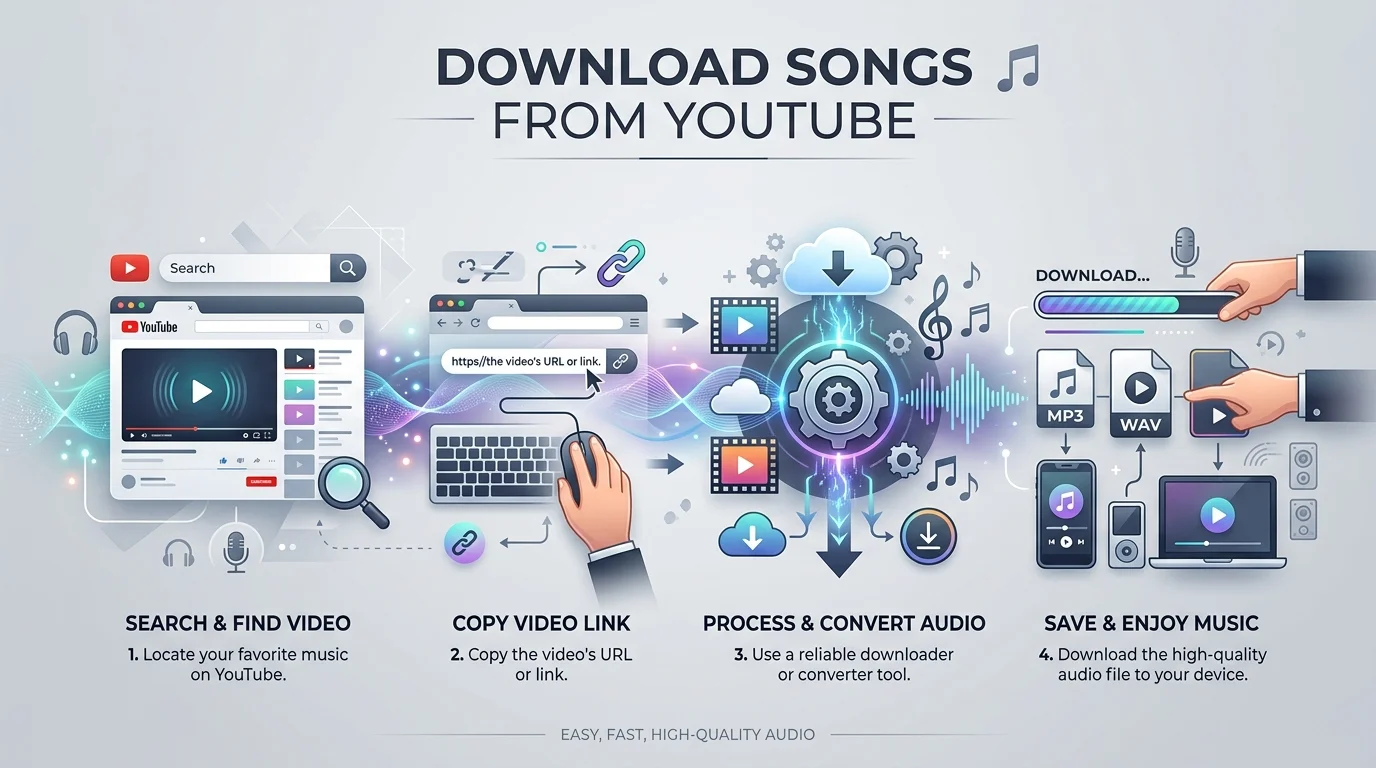
Your Four Options at a Glance
Before the detail, here's the whole landscape in one place. I built this table because every other article on this topic makes you read 2,000 words to figure out what you can actually do.
YouTube Premium | Creative Commons | Purchased MP3 | Converter Sites | |
|---|---|---|---|---|
Legal status | ✅ Fully authorised | ✅ Licence-dependent | ✅ Fully legal | ❌ Violates ToS + likely DMCA |
Do you own the file? | ❌ Encrypted, app-locked | ✅ Yes | ✅ Yes, DRM-free | ✅ Yes, but unlawfully |
Max audio quality | 256kbps AAC | Varies by uploader | Up to 24-bit lossless | Usually 128kbps |
Catalogue size | 100M+ tracks | Independent artists only | Anything for sale | Anything on YouTube |
Expires? | ✅ Yes, on cancellation | ❌ Never | ❌ Never | ❌ Never |
Offline resync needed | Every 30 days | None | None | None |
Malware risk | None | None | None | High |
Cost | Monthly subscription | Free | Per track or album | "Free" |
Notice the row that matters most: expires. We'll come back to it.
Why Most "Free YouTube Downloader" Advice Is Quietly Wrong
Search this topic and you'll drown in listicles. Ten tools, twenty tools, each promising free song downloads from YouTube in one click. What those posts skip is the clause that actually governs you, which sits in YouTube's Terms of Service and states that you may not access, reproduce, or download any part of the Service except as the Service expressly authorises.
That's not a grey area. That's a contract you agreed to.
But here's where it gets genuinely interesting, and where the listicles go silent.
The Court Case That Changed Everything
In 2020, a stream-ripping service called Yout sued the RIAA, arguing its tool didn't violate the Digital Millennium Copyright Act. The district court disagreed. As TorrentFreak reported on the appeal, the judge found Yout had failed to show it doesn't circumvent YouTube's technological protection measures, the so-called rolling cipher. Circumvention is precisely what Section 1201 of US copyright law forbids.
Yout appealed. The case is still live at the Second Circuit.
And the guest list is remarkable. The Copyright Alliance filed in support of the RIAA. The Electronic Frontier Foundation filed against, warning the ruling guts fair use. Then in October 2025, AI music companies Suno and Udio entered the fight, because the major labels accuse them of stream-ripping YouTube to build training data.
So when someone tells you converters are "probably fine," understand that a federal appeals court currently disagrees, and billion-dollar companies are litigating over it right now. If you want the underlying rules in plain English, our explainer on YouTube copyright and downloading breaks down what's protected and what isn't.
The Legal Method: YouTube Premium Offline Downloads
YouTube Premium offline download is the only sanctioned way to take commercial music off the platform, and honestly? It works better than the sketchy alternatives. You get YouTube Music Premium bundled in, ad-free playback, background play, and 256kbps audio on eligible tracks.
I'll be straight with you about the trade-off shortly. First, the mechanics.
Step-by-Step: Saving Songs for Offline Listening
Here's the whole process. Ninety seconds, start to finish.
Step 1. Subscribe to YouTube Premium or YouTube Music Premium. Music Premium is the cheaper tier if you only care about audio.
Step 2. Open the YouTube Music app. Desktop works through the progressive web app, though mobile is where downloads actually live.
Step 3. Find your song, album, or playlist. Tap the three-dot menu, then Download. Playlists have a download arrow right on the detail page.
Step 4. Set your quality. Settings → Downloads & storage → Audio quality. Low sits around 48kbps, Normal at 128kbps, High at 256kbps. Pick High unless storage is genuinely tight.
Step 5. Toggle on Smart Downloads. Per YouTube's own Help documentation, recommended content is then added to your library automatically for offline listening. It runs on Wi-Fi only, so your data plan is safe.
Step 6. Find everything under Library → Downloads.
Done. No malware, no account risk, no lawyers.
On Android
The download arrow appears directly on album and playlist detail pages. Smart Downloads lives under your profile photo → Settings → Downloads & storage. Android also lets you set a storage cap so downloads don't quietly eat your phone.
On iPhone and iPad
Identical flow, with one wrinkle. iOS restricts background downloading more aggressively, so keep the app in the foreground until a large playlist finishes. Downloaded audio stays inside the app sandbox and won't appear in the Files app or in Apple Music.
The Catch Nobody Mentions
Now the honest part, because I'd rather you hear it from me than discover it mid-flight.
Premium downloads are not MP3 files. They're encrypted, app-locked, and tethered to your account. You cannot export them, drop them into a DJ set, burn them, or move them to a device that doesn't run YouTube Music.
More importantly, YouTube Music's Help page states that you must reconnect to the internet at least once every 30 days to maintain your downloads. When your subscription lapses, every downloaded song disappears.
You're renting offline access. You're not buying music.
Worth it? For most people, genuinely yes. You get an entire catalogue for roughly the price of two albums a year. But if you want files you actually own, keep reading.
Genuinely Free and Fully Legal Alternatives
Not everyone wants a subscription. Fair enough. There are legitimate routes to free music downloads that carry zero legal risk, and they're better than their reputation suggests.
The catch is that you won't find chart hits here. You'll find working musicians, production libraries, and archives, which, depending on what you need the music for, may be exactly right.
YouTube Audio Library
The YouTube Audio Library lives inside YouTube Studio and offers thousands of royalty-free tracks you can download as real files. Free, legal, permanent. Some require attribution, most don't. If you're making videos, podcasts, or reels, start here.
Creative Commons Tracks
Filter YouTube search by Creative Commons licence and you'll surface a large body of independent music. One warning: Creative Commons licences are not uniform. Some block commercial use. Some require your derivative work to carry the same licence. Check the specific licence on the specific video before you touch it.
Buy the Track Outright
Old-fashioned, still excellent. Bandcamp sells DRM-free downloads and sends a strikingly large share to the artist. Qobuz handles high-resolution purchases. You get a real file, forever, in whatever format you like.
Understanding Audio Formats and Bitrate
Quick technical detour, because the format question decides whether your downloaded music sounds good or sounds like a phone call.
M4A vs MP3 is the most common confusion. M4A is a container holding AAC codec audio, which is what YouTube and YouTube Music actually serve. AAC beats MP3 at equivalent bitrate, so a 256kbps AAC file sounds noticeably better than a 256kbps MP3.
This matters enormously for converters.
YouTube already compressed that audio once. Converting it to MP3 compresses it a second time, and transcoding loss stacks. You cannot recover detail that the first encode discarded. A 128kbps MP3 ripped from a 256kbps AAC stream is roughly the worst version of that song in existence.
If you want lossless audio, no YouTube route gets you there. Buy a FLAC from Qobuz or Bandcamp instead.
Why Converter Sites Are a Bad Deal Even Ignoring the Law
Set the legal argument aside completely. Purely on quality and safety, YouTube to MP3 converters are a poor trade. We've covered the security side in depth in our guide to whether YouTube to MP3 sites are safe, but here's the short version.
Malware and malicious ads. Converter sites monetise through the ugliest ad networks on the web. Fake download buttons, forced browser notifications, and drive-by installers are standard.
No metadata. No ID3 tags, no album art, no track numbers. Your library becomes a folder called video_1.mp3, video_2.mp3.
Account risk. YouTube can terminate accounts for terms violations, and that account probably holds your Gmail.
Sites vanish. The one you bookmark today gets a DMCA notice next month.
My Recommendation, Plainly
If you want music offline on your phone and you want it to work every single time, subscribe to YouTube Music Premium. It's the strongest value in this entire category: the largest music catalogue in existence, including live versions, remixes, and DJ sets you'll find nowhere else, plus ad-free YouTube on top. Start the free trial and cancel if you hate it. You'll have offline playlists running within two minutes of signing up.
If you need files you truly own, buy them on Bandcamp.
If you're producing content, pull from the Audio Library.
What you shouldn't do is hand your browser to a converter site to save a few dollars while a federal appeals court decides whether that behaviour is a crime.
Frequently Asked Questions
Can you download songs from YouTube for free?
Yes, but only specific songs. Tracks in the YouTube Audio Library, music released under a Creative Commons licence, and public domain recordings can be downloaded free and legally. Commercially released music cannot, unless you subscribe to YouTube Premium.
Is it illegal to download music from YouTube?
For most commercial music, yes. Three separate problems apply simultaneously: copyright infringement through unauthorised reproduction, DMCA anti-circumvention under Section 1201, and breach of contract with YouTube. A US district court ruled in the Yout case that stream-ripping violates the DMCA, and that decision is currently under appeal at the Second Circuit.
Can you export YouTube Music downloads as MP3 files?
No. Premium downloads are encrypted and locked inside the YouTube Music app. There is no export function, and the files are not readable by other music players.
What happens to downloaded songs if I cancel Premium?
They stop working. Offline downloads are tied to an active subscription. Once it ends, your downloaded library becomes inaccessible.
Do YouTube Music downloads expire?
Yes. You must reconnect to the internet at least once every 30 days to keep your downloads active. Miss that window and the library locks until you go back online.
Are YouTube to MP3 converters safe?
Generally no. These sites rely on low-quality ad networks associated with malware distribution, fake download buttons, and unwanted browser notifications. They also output heavily compressed audio, usually at 128kbps, with no metadata attached.
How do I download Creative Commons music from YouTube?
Filter YouTube search results by Creative Commons licence, then check the individual video's licence terms, which appear in the description. Some licences permit commercial use and some don't. Contact the uploader directly if the terms are unclear.
Can YouTube ban you for using a downloader?
Yes. Using third-party download tools violates YouTube's Terms of Service, and YouTube reserves the right to suspend or terminate accounts for terms violations. Since your YouTube account is your Google account, that risk extends to Gmail and Drive.