Is YouTube to MP3 Safe? The Real Risks (2026)
Is YouTube to MP3 Safe? YouTube to MP3 conversion is not dangerous in itself, but many of the websites offering it are. The FBI has warned that free converter and downloader tools can deliver hidden malware while working exactly as advertised, and security researchers found that nearly 80% of sites in this ecosystem serve malicious ads. There is a separate legal question that remains unresolved in a U.S. federal appeals court. This guide separates the two risks and shows you how to tell a clean tool from a hostile one.
That is the short version. Now let me show you the evidence.
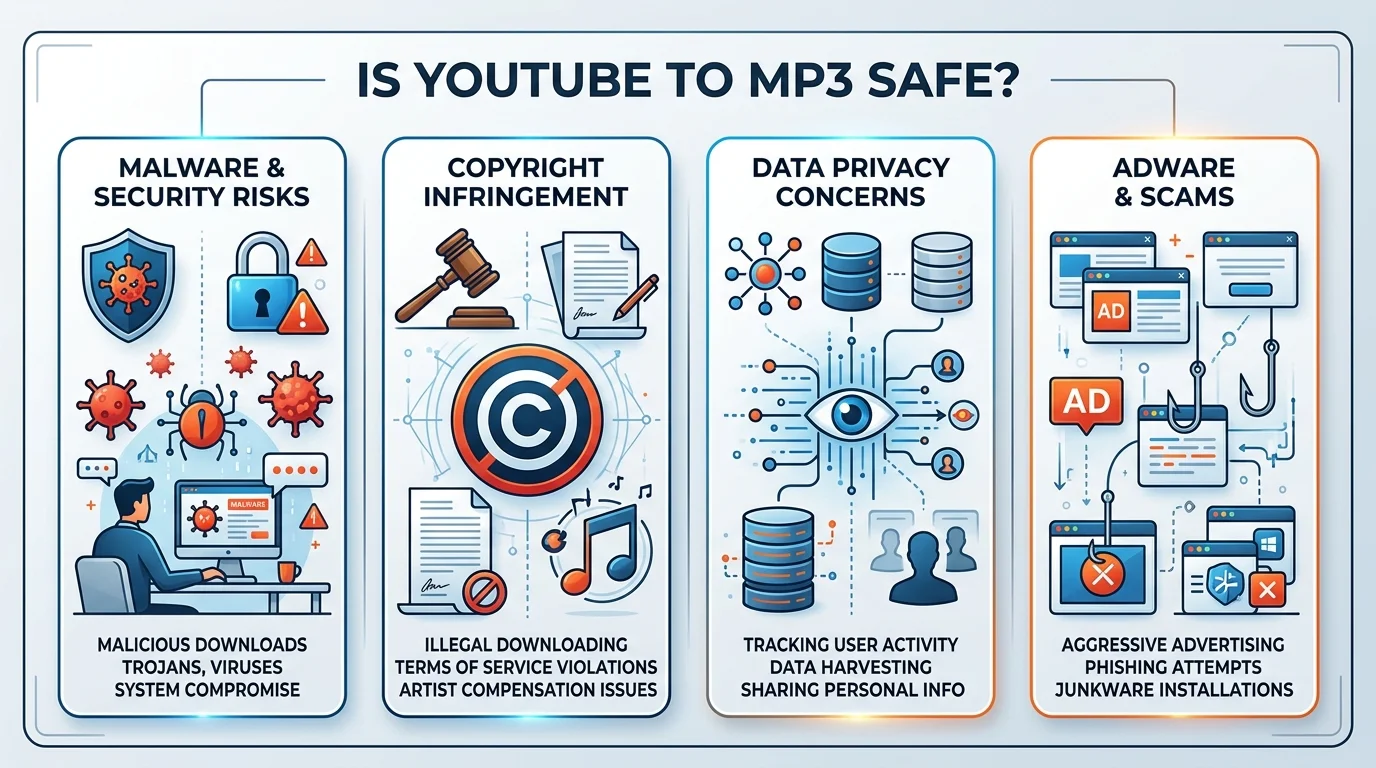
What "Safe" Actually Means Here (Two Risks, Not One)
Most articles on this subject blend two very different problems into one vague warning, which is why they leave you no better informed than when you arrived. You want to know whether something bad will happen to you, and "it's a gray area" answers nothing.
So I am splitting them apart.
Risk one is device security. Will a YouTube to MP3 converter infect your computer, hijack your browser, or expose your data?
Risk two is legal exposure. Does stream ripping break copyright law or put your account at risk?
These have different answers, different evidence, and different severity. Let's take them in order.
Risk One: The FBI Named This Exact Tool Category
I went looking for a credible source on converter malware and expected marketing fluff. Instead I found a federal alert.
In March 2025, the FBI Denver Field Office published a warning about free online converter tools being used to load malware onto victims' computers. The alert explicitly covers programs claiming to be MP3 or MP4 downloaders. Not just document converters. The exact category you are researching right now.
Here is the detail that changed how I think about this.
The tool works.
You paste your link, you receive your file, and nothing looks wrong. According to the Bureau, that resulting file can carry hidden malware granting criminals access to your machine, and the site can scrape whatever you submitted for personal information along the way. Most victims only find out later, once ransomware has run or their identity has been used.
Malwarebytes corroborated the alert and added something the FBI did not spell out. Alongside ransomware, they have tracked these sites installing browser hijackers, adware, and potentially unwanted programs.
So the honest answer to "would I notice?" is usually no. That is the design.
Risk Two: The Ads Are More Dangerous Than the Download
This is the part almost nobody covers, and it is the most useful thing in this article.
You can be compromised without downloading anything at all.
Malvertising is the mechanism. Free converter sites do not charge you, so their revenue comes entirely from advertising. Mainstream ad networks will not work with the sketchier operators, which leaves the unvetted bottom tier. A joint investigation by the Digital Citizens Alliance, White Bullet, and Unit 221B found that nearly 80% of piracy-adjacent sites served malware-laden ads, generating an estimated 321 million harmful impressions and $121 million in revenue for site operators.
During that research, investigators clicked one ad and triggered a live ransomware attack. Files encrypted, payment demanded.
A 2025 paper for the Alliance for Creativity and Entertainment explains the technical route. Attackers inject malicious JavaScript through shared ad networks and unpatched site code, which enables drive-by downloads and credential theft on sites whose owners may not even be involved.
The takeaway is uncomfortable but important. The advertising model is the vulnerability, not the audio extraction. Which also means the risk is avoidable rather than inherent.
Warning Signs Worth Memorizing
Whatever tool you end up using, these are the tells that should make you close the tab immediately.
Several download buttons on one page. Only one is real. The rest are ads styled to look native.
A push notification request. No legitimate converter needs to send messages to your desktop.
A required browser extension. This is the highest-risk pattern on the list. Leave.
A file that is not an .mp3. If you receive an
.exe,.dmg, or.scr, that download was never audio. Our guide to why a YouTube video will not convert covers what a genuine failure looks like instead.A domain that is almost right. The FBI told BleepingComputer that scammers change a single letter to mimic real services, and that paid search results make even careful searching risky.
That last point deserves emphasis. You can search carefully, click the top result, and still land somewhere hostile. If you are evaluating options, our comparison of the best YouTube to MP3 sites applies these criteria across the main tools people use.
Is Converting YouTube to MP3 Illegal?
Now the legal side, which is messier than most publishers admit. There are two layers, and only one of them is settled.
Layer One: YouTube's Terms of Service
This layer is not ambiguous. The YouTube Terms of Service state that you may not access, reproduce, or download Content except as expressly authorized by the Service, and that you may not circumvent features restricting the copying of Content.
Using a stream ripper breaches that agreement. The consequence is contractual rather than criminal, but if you are signed in, your Google account is what is exposed.
Layer Two: U.S. Copyright Law (Still Being Argued)
In 2022, a Connecticut federal judge ruled in Yout LLC v. RIAA that YouTube's rolling cipher qualifies as a technological protection measure, and that ripping around it violates Section 1201 of the DMCA, the anti-circumvention provision administered through the Copyright Office's triennial rulemaking.
Yout appealed. As of this update, the Second Circuit has not ruled, with both sides still filing supplemental authority letters in March 2026.
The alignment in that case is genuinely unusual. GitHub and the EFF filed in support of Yout. The Copyright Alliance backed the RIAA. In October 2025, AI music companies Suno and Udio filed a brief arguing the ruling would expose documentary filmmakers and teachers to statutory penalties.
Anyone telling you this is settled, in either direction, is skipping an active federal appeal. Treat it as unresolved.
Narrow exceptions do exist and are worth knowing. Your own uploads, Creative Commons licensed material, and public domain audio sit in a different position entirely. Our deeper explainer on YouTube copyright and downloading walks through where those lines fall.
Your Options Compared
Research from IFPI found that 55% of people who stream-rip do it specifically to avoid a subscription fee. Cost drives the behavior, so an honest comparison has to price each route against the risk it carries.
Option | Malware risk | Legal exposure | Cost | Offline playback |
|---|---|---|---|---|
Ad-heavy free converter | High (FBI-flagged; malvertising) | Unresolved, plus ToS breach | Free | ✅ |
Clean browser-based converter | Low if no ads, extensions, or executables | Unresolved, plus ToS breach | Free | ✅ |
YouTube Premium | None | None | Paid monthly | ✅ |
Local tool, your own files | Low (nothing uploaded) | None for your own content | Free | ✅ |
The security column and the legal column move independently. A clean tool solves the first problem entirely and does nothing for the second.
A Safer Step-by-Step Approach
Step 1: Define what you actually need. Offline listening, background playback, and a clip for a project are three different problems. If it is audio quality you care about, our breakdown of 320kbps YouTube conversion explains what bitrate actually buys you.
Step 2: Check the official route first. YouTube Premium provides sanctioned offline downloads and background play. It removes both risk categories in this article at once, which makes it the right answer for anyone whose main goal is simply listening offline.
Step 3: If you use a web converter, audit it before pasting anything. Run the warning-sign checklist above. A tool with no ad clutter, no extension requirement, and no executable downloads eliminates the attack surface described in the FBI alert. Our guide to online YouTube to MP3 conversion covers what the process should look like when nothing is wrong.
Step 4: Never paste private, work, or paid-content links into any web tool. The FBI alert specifically notes that submitted files can be scraped. Treat every web converter as a public service, because it is one.
Step 5: Harden the browser regardless. Run a reputable ad blocker and scan unfamiliar downloads through VirusTotal before opening them. For phone users, converting YouTube to MP3 on iPhone has its own set of considerations worth reading first.
Frequently Asked Questions
Can you get a virus from a YouTube to MP3 converter?
Yes. The FBI warned in 2025 that free converter and downloader tools, including MP3 downloaders, can deliver files containing hidden malware while still performing the advertised conversion correctly.
Do YouTube to MP3 sites steal your data?
They can. The FBI alert states these tools may scrape submitted files for personal identifying information, and security vendors have documented browser hijackers and spyware installed through the same sites.
Is YouTube to MP3 illegal in the US?
Unresolved. A 2022 district court ruling found that stream ripping circumvents a technological protection measure under DMCA Section 1201, but that decision is under appeal at the Second Circuit and has not been finally decided.
Is it illegal in the UK and EU?
Copying copyrighted material without permission infringes copyright in both, and the UK has no general private-copying exception, so the copying itself is unlawful there regardless of the U.S. case.
Can YouTube ban you for downloading? Yes. Downloading through third-party tools breaches the Terms of Service, and YouTube reserves the right to restrict or terminate account access for material breaches.
Is a converter safe if the site uses HTTPS?
No. HTTPS encrypts the connection between you and the site. It says nothing about whether the site's ads are hostile or whether the file you receive is clean.
Is downloading your own uploads allowed?
Yes. Your own content, Creative Commons licensed material, and public domain audio sit outside the copyright problem entirely.
The Verdict
YouTube to MP3 conversion is only as safe as the site performing it.
The federal warning is real. The malvertising data is real. Both point at the same culprit, and it is not the audio extraction. It is the advertising model wrapped around it, which is exactly why the checklist in this article works.
The legal question is separate, unresolved, and applies no matter which tool you pick. Downloading your own uploads or Creative Commons audio avoids it. Ripping commercial music does not.
Choose deliberately on both counts.