What Does GPT Stand For? Full Meaning Explained
GPT stands for Generative Pre-trained Transformer — a type of AI model that generates human-like text after being trained on massive amounts of data. OpenAI coined the term in a 2018 research paper, and it later became famous through ChatGPT. Each word in the acronym describes a specific capability: "generative" means it creates content, "pre-trained" means it learns from data before you ever use it, and "transformer" is the neural network design that makes it all work.
So you've probably seen "GPT" everywhere — in ChatGPT, in headlines, in your coworker's Slack messages — and wanted the full story behind it. Let's break it down together, piece by piece, so you walk away actually understanding it.
What Does GPT Stand For, Exactly?
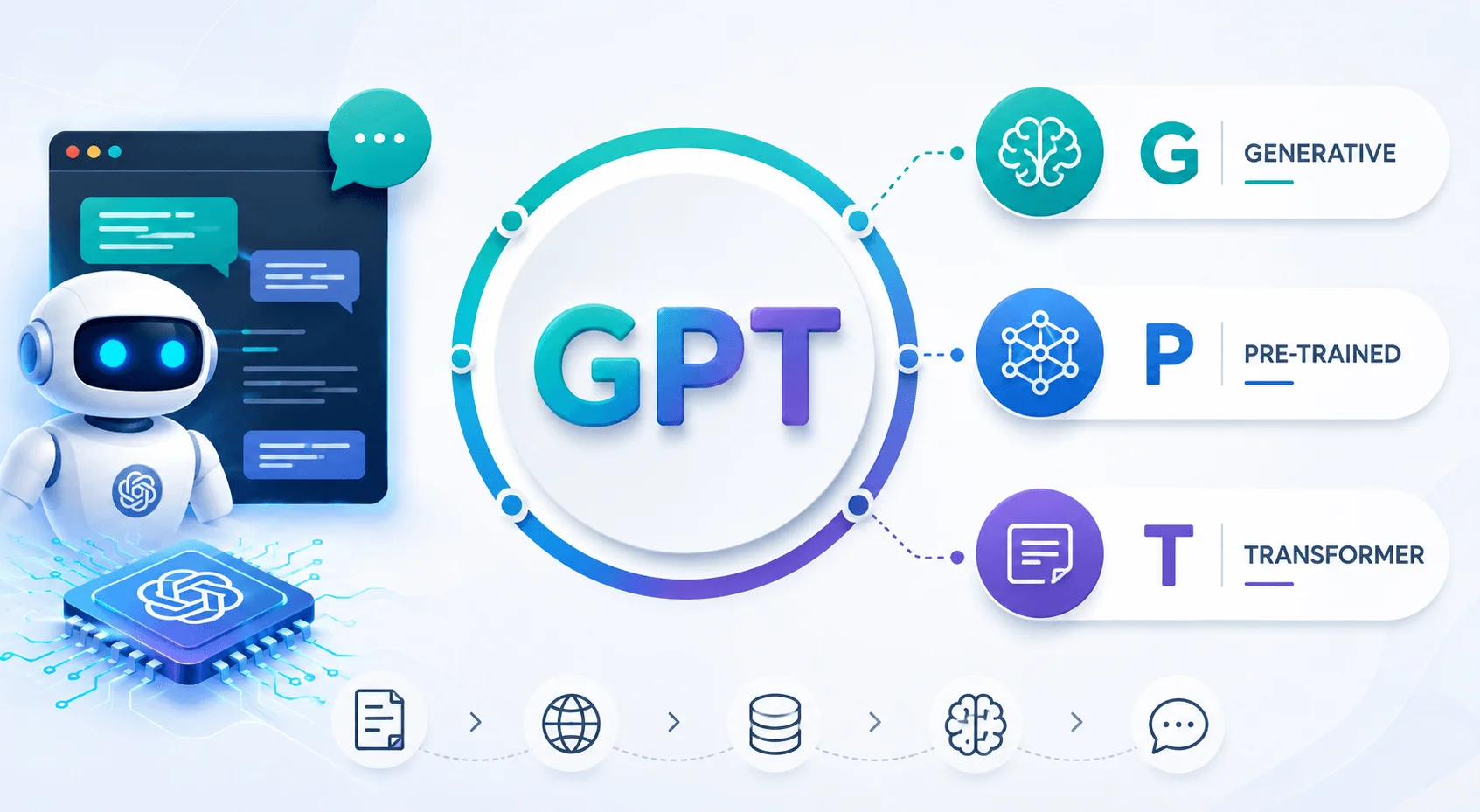
Quick gut-check before we go further: GPT is not a brand name or a single product. It's a type of AI model — a technical term describing how the thing was built.
OpenAI didn't just make this term up for fun, either. According to OpenAI's original 2018 paper, "Improving Language Understanding by Generative Pre-Training," the model used a two-stage process: unsupervised pre-training on unlabeled text, followed by supervised fine-tuning on a specific task. That paper is the actual birth certificate of GPT as we know it today.
Now, let's take those three letters one at a time.
G Is for Generative
"Generative" means the model creates new content instead of just fetching existing content.
Think about it this way: a search engine finds things that already exist. A generative AI model, on the other hand, writes brand-new sentences, one word at a time, based on patterns it learned. Nothing is copy-pasted. Nothing is "looked up." It's built, live, right in front of you.
So when you ask ChatGPT for a poem about your dog, it's not searching a poem database — it's generating one, word by word, based on probability.
P Is for Pre-trained
Here's where it gets interesting.
Before a large language model like GPT ever talks to you, it goes through extensive training on a massive pile of text — books, articles, websites, forums, and more. This is the "pre-training" stage, and per OpenAI's original paper, it happens before the model is fine-tuned or released to the public.
Why does this matter to you? It's why GPT feels like it "knows things." It's not thinking in real time from scratch — it's drawing on patterns baked in during that training phase.
Often, there's a second step too: fine-tuning, where the model gets extra, narrower training on a specific task. Pre-training gives it general knowledge; fine-tuning sharpens it for something specific.
T Is for Transformer
Okay, last letter — and this one's the real engineering marvel.
A transformer is a neural network architecture — the underlying blueprint the model is built on. It was introduced in the landmark 2017 paper "Attention Is All You Need," and it changed how AI handles language entirely.
Here's the trick transformers use: self-attention. Instead of reading a sentence strictly left to right, the model looks at every word in relation to every other word and figures out which ones matter most to each other. That's how it understands that in "the dog chased its tail," "its" refers to the dog — not some random noun three sentences earlier.
Put simply: transformers turn your text into tokens, tokens into vectors, and then weigh which ones deserve the most "attention." That mechanism is the T in GPT, and it's the backbone of nearly every modern AI language model today, including Google's BERT and other systems covered in our guide on what neural TTS is.
A Quick History of GPT (So You Sound Smart at Dinner)
You don't need a computer science degree for this — just the highlights, sourced directly from OpenAI's own release history.
Model | Release Date | Parameters / Key Detail | What Changed |
|---|---|---|---|
GPT-1 | June 2018 | ~117 million parameters | Proof of concept; introduced the GPT architecture |
GPT-2 | Feb 2019 | 1.5 billion parameters | Text suddenly sounded genuinely fluent |
GPT-3 | 2020 | 175 billion parameters | Sparked an explosion of GPT-powered apps |
GPT-4 / GPT-4o | 2023–2024 | Multimodal | "o" = "omni" — handles text, voice, and images |
GPT-5 | Aug 7, 2025 | Reasoning built-in | Folded OpenAI's separate "o-series" reasoning into the main line |
GPT-5.6 | July 9, 2026 | Three variants: Sol, Terra, Luna | Built for coding, research, cybersecurity, and enterprise work |
Worth noting: GPT-5.6's public rollout was briefly delayed, with OpenAI initially limiting it to a small group of trusted partners in late June 2026 due to U.S. government safety-review requirements, before expanding to general availability on July 9, 2026. That's a good example of how even the newest AI models now go through external safety checks before reaching the public.
See the pattern across this table? Bigger models, broader skills, faster release cycles — and that trend shows no sign of slowing down.
How GPT Actually Works (Step-by-Step)
Let's make this concrete. Here's what happens, roughly, when you type a prompt into a GPT-based tool:
Your text gets broken into tokens — small chunks of words or subwords.
Tokens get converted into vectors — numerical representations the model can actually process.
Self-attention kicks in — the model weighs how each token relates to every other token.
The model predicts the next token — over and over, one at a time, building your response.
The output gets converted back into readable text — and that's what you see on your screen.
That's the whole loop, happening thousands of times per second under the hood.
GPT vs. Other AI Models: What Makes It Different?
You've probably heard other AI buzzwords floating around too — BERT, LLaMA, Gemini, Claude. So what actually separates GPT from the rest of the pack?
Here's the honest answer: many of them share the same underlying transformer architecture. The differences come down to how they're trained, what they're trained on, and how they're structured internally.
Model | Developer | Reads Text | Best Known For |
|---|---|---|---|
GPT | OpenAI | Left-to-right (generative) | Text generation, ChatGPT |
BERT | Bidirectional (both directions at once) | Understanding search queries | |
Claude | Anthropic | Left-to-right (generative) | Reasoning, safety-focused design |
Gemini | Left-to-right (generative) | Multimodal tasks, Google ecosystem integration |
Think of it this way: BERT is a fantastic reader — built to understand language, which is why Google uses it to interpret search queries. GPT is a fantastic writer — built to generate language, one token at a time, moving forward.
As for Claude or Gemini — technically, no, they aren't GPT models, even though they share the same transformer DNA under the hood. "GPT" specifically refers to OpenAI's model family and the architecture it popularized under that name. Each company tunes its own models differently: different training data, different safety guardrails, different fine-tuning priorities.
Common Misconceptions About GPT (Let's Clear These Up)
I want to bust a few myths here, because I see these constantly.
Myth #1: GPT is the same thing as ChatGPT.
Nope. GPT is the underlying model architecture. ChatGPT is the product — the chat interface built on top of a GPT model. GPT is the engine; ChatGPT is the car.
Myth #2: GPT "thinks" like a human.
Not quite. GPT predicts the most statistically likely next word based on patterns in its training data. It doesn't reason the way you and I do — though newer models are getting closer with added reasoning capabilities layered on top, as seen in GPT-5.
Myth #3: GPT knows everything, up to the current moment.
Also not true. Every GPT model has a training cutoff. Anything that happened after that cutoff is a blind spot, unless the tool has internet access bolted on separately.
Myth #4: Bigger GPT models are always better.
Not necessarily. As the table above shows, newer releases increasingly focus on efficiency and reasoning quality, not just raw parameter count. Smaller, well-tuned models can sometimes outperform older giants on specific tasks.
Why Understanding GPT Actually Matters for You
Here's the thing: you don't need to be a machine learning engineer to benefit from this.
If you're a content creator, understanding how GPT generates text helps you prompt it better, spot its blind spots, and use it as a tool instead of a crutch. For more on picking the right tools, see our roundup of AI search optimization tools.
If you're a business owner, knowing the difference between pre-training and fine-tuning helps you make smarter decisions about which AI tools to adopt — and which ones are just repackaging the same technology under a new logo. Our AI tools comparison guide breaks that down further.
And if you're simply a curious person who wants to keep up with the times? Well, now you know more than most people typing "gpt" into Google today.
Frequently Asked Questions About GPT
What does GPT stand for?
GPT stands for Generative Pre-trained Transformer — a type of AI model that generates text after being trained on massive datasets using transformer architecture, according to OpenAI's original 2018 paper.
What does the "G" in GPT mean?
"G" stands for Generative, meaning the model creates new content rather than retrieving existing content.
What does the "P" in GPT mean?
"P" stands for Pre-trained, referring to the model's initial training phase on large amounts of text data before it's released or fine-tuned.
What does the "T" in GPT mean?
"T" stands for Transformer, the neural network architecture — introduced in the 2017 paper "Attention Is All You Need" — that uses self-attention to process and generate language.
Who created GPT and when?
OpenAI introduced GPT in a 2018 research paper, with GPT-1 as the first model in the family, released that June.
Is GPT the same as ChatGPT?
No. GPT is the underlying model architecture; ChatGPT is the consumer-facing product OpenAI built on top of its GPT models.
Is GPT free to use?
Some GPT-based tools, like certain ChatGPT tiers, offer free access, while more advanced models like GPT-5.6 and higher usage limits typically require a paid subscription.
What does the "o" mean in GPT-4o?
The "o" stands for omni, referring to the model's ability to process and generate text, audio, and visual content in real time.
What is the newest GPT model as of 2026?
As of July 2026, GPT-5.6 is OpenAI's newest release, available in three variants — Sol, Terra, and Luna — built for enterprise work, coding, research, and cybersecurity.
Final Thoughts
So, next time someone asks you "what does GPT stand for," you've got the full answer: Generative Pre-trained Transformer — plus the story behind each word, a verified history from GPT-1 through GPT-5.6, and a clear sense of how it stacks up against models like BERT and Claude.
It's not magic. It's math, data, and a clever transformer architecture that changed how machines handle language. Now you know exactly how it works — and that puts you ahead of most people still just typing questions into a chatbot without a clue what's happening underneath.
Want more explainers like this? Check out our AI news and updates section for the latest on models like this one.