What Is Neural TTS? The Guide to AI Voices
Neural TTS is a technology that turns written text into natural, human-sounding speech using deep learning. Unlike older systems that stitched together robotic audio clips, neural TTS builds speech from scratch, learning tone, rhythm, and pronunciation from real human recordings. This is why platforms today can produce a convincing AI voiceover for a video, an audiobook, or a customer service call, and listeners often can't tell it apart from a real person. The shift matters because businesses, creators, and accessibility tools all depend on synthetic speech that sounds trustworthy, not mechanical. In this guide, we'll cover exactly how neural text-to-speech works, where it shows up daily, and which providers currently lead the field. No jargon overload. Just clear answers. If you're generally curious about how AI is reshaping audio and video tools, our AI Audio & Video Tools hub covers a wider range of topics like this one.
What Is Neural Text-to-Speech?
Neural text-to-speech is a method of turning written words into spoken audio using deep neural networks (DNN). Instead of splicing together pre-recorded audio clips like older systems did, it builds speech from scratch. The model learns rhythm, tone, and pronunciation directly from thousands of hours of real human recordings.
This matters more today than ever before. Businesses need AI voiceover content fast, and they need it to sound genuine, not mechanical. Neural text to speech delivers exactly that. It's the engine behind modern AI voice generators, and it's why synthetic speech no longer sounds synthetic at all.
How Neural TTS Works (Step-by-Step)
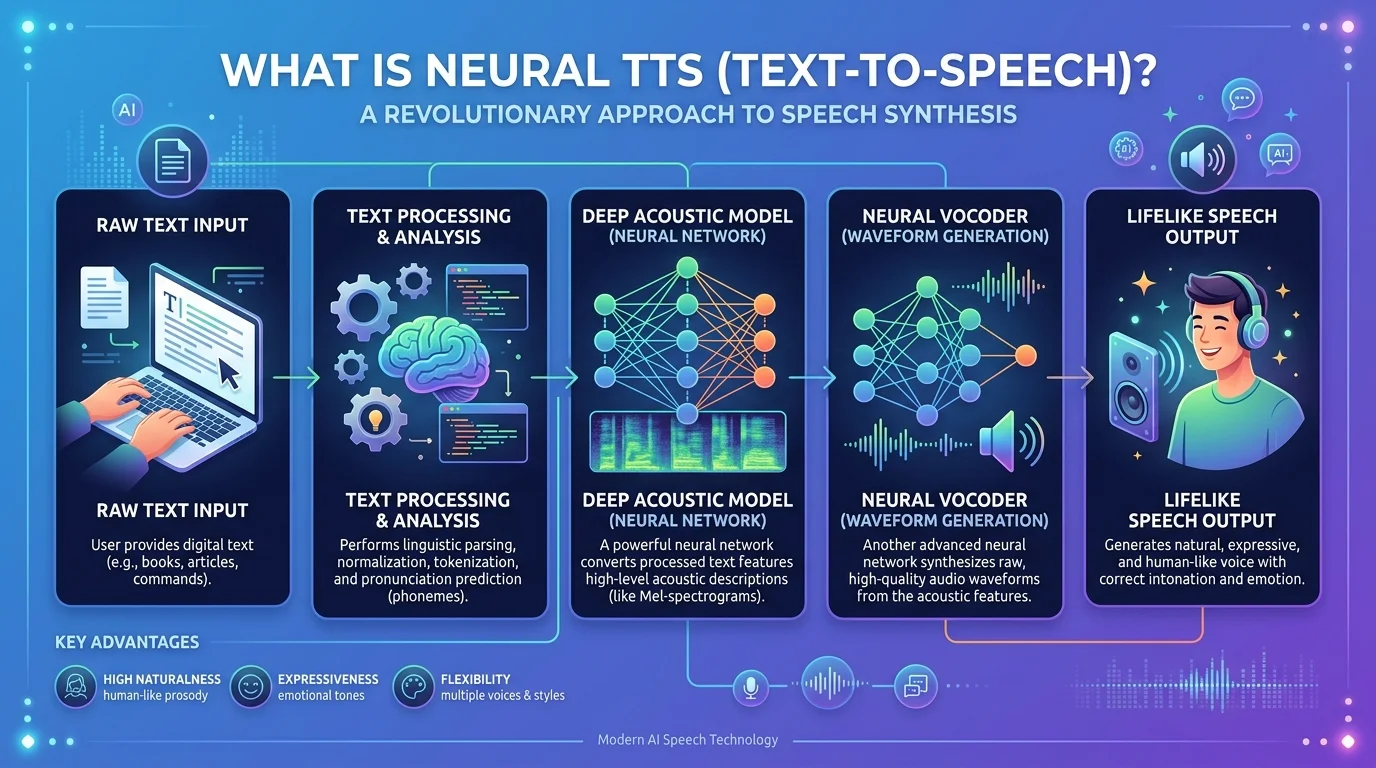
Every neural TTS system, no matter the provider, follows roughly the same three-stage process. It starts with reading the text, moves into predicting how that text should sound, and ends with generating the actual audio waveform. It sounds simple on paper. Under the hood, it's a genuinely complex piece of engineering.
Let's walk through each stage, because understanding this pipeline helps explain why neural text-to-speech sounds so much more natural than the TTS systems from a decade ago.
Text Analysis & Linguistic Processing
The first step breaks written text into phonemes, the smallest sound units in any language. The model reads punctuation as timing cues too. A comma signals a short pause. A question mark lifts the pitch near the end of a sentence. This is where the system starts to understand meaning, not just spelling.
Acoustic Modeling (Duration, Pitch & Prosody Prediction)
Next comes the acoustic model. This stage predicts pitch and duration for every phoneme, along with broader prosodic parameters like rhythm and stress. A sequence-to-sequence model maps the phoneme sequence into a mel-spectrogram, which is essentially a visual map of pitch, tone, and timing over the sentence.
Neural Vocoder / Voice Rendering
The final stage hands that spectrogram to a vocoder. A neural vocoder converts the spectrogram into an actual audio waveform, ready to play. This is where waveform generation happens, and it's the step that turns a mathematical prediction into a voice you can actually hear through your speakers.
Neural TTS vs. Traditional TTS (Concatenative & Parametric)
Older text-to-speech systems relied on concatenative synthesis, which means chopping up studio recordings into tiny fragments and gluing matching pieces back together. It worked, technically. But it always sounded choppy, because human speech doesn't move in neat little fragments. Parametric synthesis came next, replacing fragments with mathematical models. That fixed the choppiness but introduced a new problem: everything sounded flat.
Neural TTS solves both problems at once. It doesn't stitch anything together, and it doesn't rely on rigid math formulas either. It learns speech patterns from data, the same way a person learns to talk by listening. Here's how the three approaches stack up side by side.
Feature | Concatenative TTS | Parametric TTS | Neural TTS |
|---|---|---|---|
Voice source | Pre-recorded fragments | Mathematical models | Deep neural networks |
Naturalness of speech | Choppy, robotic | Smooth but flat | Human-like |
Emotional range | None | Minimal | Expressive |
Customization | Very limited | Moderate | Full — cloning, style control |
Best suited for | Basic alerts | Legacy systems | Content, avatars, dubbing |
Why Neural TTS Sounds More Human
The short answer is data. Deep learning models learn how real people actually speak, capturing emphasis, pacing, and pitch shifts that older rule-based systems could never replicate. That's the entire difference between a robotic vs human voice and one that sounds like a friend explaining something to you.
Prosody and Natural Rhythm
Prosody refers to the rhythm and stress pattern across a full sentence, not just individual words. Traditional systems assign a fixed stress value no matter the context. Neural text-to-speech learns intonation and rhythm from real recordings, so emphasis shifts naturally depending on what the sentence actually means.
Emotional Range and Speaking Styles
Neural TTS can sound calm, urgent, warm, or upbeat, depending on the speaking style you choose. This emotional range is a genuine game-changer for content that needs to connect, not just inform. A conversational tone on a product video, for example, keeps viewers watching far longer than a flat, monotone narration ever could.
Key Benefits of Neural Text-to-Speech
The biggest win with neural text-to-speech is naturalness, but that's really just the starting point. You also get scalability that no human voice actor could match, since one script can generate unlimited audio variations in minutes. Cost and time savings follow close behind. No studio booking, no re-recording sessions, no waiting on a voice actor's schedule.
Accessibility is another major benefit, since neural TTS powers screen readers and reading tools for people with visual impairments or reading difficulties. And for brands, there's a subtler win too: voice persona consistency. One chosen voice can represent your brand across every video, every app, and every customer interaction, without ever sounding tired or inconsistent. As one industry note from ReadSpeaker's Jean-Rémi Larcelet-Prost puts it, custom neural voices help "transform personal computers into personable computers."
Advanced Neural TTS Capabilities
Neural TTS isn't just about generating a single flat voice anymore. The technology has grown into something far more flexible, letting brands and creators shape voices to their exact needs. This section covers the more advanced tricks the technology now supports.
These capabilities are what separate a basic text-to-speech synthesis tool from a genuinely powerful AI voice generation platform, and they're worth understanding before you pick a provider.
Voice Cloning & Speaker-Adapted Models
Voice cloning trains a model on a short audio sample to replicate a specific person's voice. Thanks to transfer learning and speaker adaptation, this no longer requires hours of recordings. A few minutes, sometimes even seconds, is often enough to produce a convincing clone.
Prosody Transfer
Prosody transfer lets you combine the rhythm and delivery style of one voice with the tonal quality of another. It's useful when you love how one voice sounds but prefer the speaking energy of a different recording entirely.
Multilingual and Cross-Lingual Voices
Modern neural text to speech systems can switch between languages while keeping the same voice persona intact. This supports multilingual dubbing and lets global brands maintain one consistent voice identity across every market they operate in.
Real-World Applications of Neural TTS
Neural TTS shows up in far more places than most people realize. It's woven into daily life quietly enough that you've probably interacted with it today without noticing. Below is a look at where this technology delivers the most value right now.
Each use case leans on a slightly different strength of the technology, from expressiveness to speed to language coverage. If you're curious how AI is changing adjacent fields too, check out our roundup of AI news and updates for a broader view of where this space is heading.
Accessibility & Reading Assistance
Screen readers and reading assistance tools rely heavily on neural TTS to support people with visual impairments, dyslexia, or ADHD. Clear, natural natural language speech output makes digital content usable for millions of people who'd otherwise struggle with text-only formats.
Video, Podcast & Audiobook Production
Video voiceover work, audiobooks and podcasts all benefit enormously from neural TTS. Creators can generate professional narration without booking studio time or hiring voice talent, and they can regenerate a line instantly if a script changes. If you work with audio pulled from video content, our guide on how to pull audio from a YouTube video is a handy companion resource for creators building out a full production workflow.
Enterprise & Conversational AI (IVR, assistants)
IVR systems, virtual assistants, and conversational AI platforms all depend on neural TTS for natural-sounding, real-time responses. Customer service automation has improved dramatically because callers now hear a voice that sounds attentive, not robotic.
Localization at Scale
Multilingual dubbing lets one video get translated into dozens of languages without hiring separate voice actors for each region. This is localization at scale, and it's reshaping how global companies approach content distribution entirely.
Popular Neural TTS Models and Tools
Several major providers now offer cloud-based TTS services built on neural text-to-speech technology, and it's worth knowing the landscape before choosing one. Amazon Polly offers a neural engine built around a sequence-to-sequence model paired with a vocoder, converting phonemes into spectrograms before rendering final audio.
Azure Speech, part of Microsoft Azure, offers HD voice models including DragonHD, Dragon HD Omni, and Dragon HD Flash, with fine control through parameters like temperature, top_p, top_k, and cfg_scale, plus a feature called enhancePronunciation for tricky words. Google Cloud TTS builds on research from Google DeepMind, whose 2016 model WaveNet first proved neural networks could generate raw audio waveforms directly. Google later introduced Tacotron and Tacotron 2, which achieved a Mean Opinion Score (MOS) of 4.53 out of 5, nearly matching professional human recordings.
Other notable names include ReadSpeaker, known for its speechEngine SDK and proprietary VTML markup language for emotional control, CAMB.AI, whose MARS8 model family includes MARS-Flash, MARS-Pro, MARS-Instruct, and MARS-Nano for different deployment needs, and ImagineArt Audio Studio, which pairs neural TTS with voice cloning and a Lipsync Studio for full audio-to-video production. Writer Tooba Siddiqui has covered how these combined tools give creators a full production pipeline in one place.
Provider | Known For | Best Fit |
|---|---|---|
Amazon Polly | Wide voice library, SSML support | General cloud applications |
Azure Speech | HD voices, style control | Enterprise, expressive content |
Google Cloud TTS | WaveNet/Tacotron lineage | High-fidelity narration |
CAMB.AI | MARS8 low-latency models | Real-time, on-device use |
ImagineArt | TTS + cloning + lipsync | Video creators, all-in-one workflow |
Where Neural TTS Is Heading: Future Trends
Neural TTS keeps evolving fast, and a few clear trends are shaping where it goes next. These shifts matter if you're choosing a platform today, since the right provider now should also support where the technology is headed tomorrow.
On-Device and Edge TTS
Not every application can rely on a stable internet connection. On-device TTS and edge computing now let high-quality neural voices run locally, on everything from train announcement systems to handheld devices, without sending data anywhere.
Ultra-Low Latency for Conversational AI
Real-time synthesis is critical for voice-first conversation. Modern systems now measure Time-to-first-byte (TTFB) in the range of 100 milliseconds, delivering low latency speech fast enough to feel like a natural back-and-forth chat.
Privacy-First Voice Technology
Industries like healthcare and finance can't compromise on data handling. Privacy-first technology running on-premise, often backed by standards like ISO/IEC 27001:2022, ensures sensitive text never leaves an organization's own infrastructure.
Common Mistakes to Avoid When Using Neural TTS
Plenty of people jump into neural TTS and get disappointing results, usually because of a few avoidable mistakes. The most common one is picking a mismatched speaking style for the content type. A cheerful, upbeat tone on a serious corporate explainer feels jarring, and the reverse is just as awkward.
Another frequent slip-up is ignoring punctuation as a pacing tool. Since the model reads commas and periods as timing cues, a script with missing punctuation runs sentences together in a way that sounds unnatural. It also helps to test a voice against your actual script rather than trusting the generic preview sample, since real phrasing can trip up a voice that sounded perfect in a demo. Finally, don't settle for the first generation if a line sounds off. Neural text-to-speech output varies slightly with each run, so regenerating a rough line two or three times often fixes the issue without any script changes at all. If you're building out audio content and want to strip audio from source video first, our guide on downloading audio walks through the basics before you bring it into any TTS or voiceover workflow.
Frequently Asked Questions
What is the neural TTS model?
A neural TTS model is a deep learning system, such as WaveNet or Tacotron, that generates human-like speech directly from text without stitching audio clips together.
What is the difference between neural TTS and standard TTS?
Standard TTS stitches together pre-recorded audio fragments, while neural TTS generates entirely new, natural-sounding speech using deep neural networks.
What does TTS mean in AI?
TTS stands for Text-to-Speech, the AI process that converts written text into spoken, audible language.
Does TTS help ADHD? Yes, TTS can help ADHD by letting people listen to text instead of reading it, which often improves focus, comprehension, and retention.
Neural TTS has come a long way from the flat, mechanical voices of the past. It's now the backbone of AI voiceovers, smart assistants, and accessibility tools millions of people rely on daily. Whichever provider or use case you choose, understanding how neural text-to-speech actually works puts you in a much better position to pick the right tool for the job. Explore more breakdowns like this one on our blog, or head back to our homepage to see our full suite of audio and video tools.